Thursday, July 1, 2010

Fixated on Fireless Cookers


I have been fixated on fireless cookers ever since I learned about them from a friend in Mombasa this past May. I spoke about them so much that Claude threatened to start calling me Kelley 'fireless cooker' Johnson! The concept is simple: an insulted basket that allows the residual heat of the cooking vessel to complete the cooking off the fire and in the basket.

1. A woman can cook beans on the open fire for about 45 minutes, then put the pot into a fireless cooker and let it sit, unattended, for another 3 or 4 hours. The heat present in the pot, insulted in the basket, will finish the cooking process. So instead of the women sitting over the pot of beans on the fire for 4 or 5 hours, minding the fire and trying to keep the children out of the flames... she can reduce her active cooking time to 45 minutes and free the other hours for herself. She can use those additional hours to work on other things, to mind the children, or whatever else needs her attention that day. It frees her time.

2. But there is another huge advantage to fireless cookers in a rural setting - it reduces the amount of firewood or charcoal used in daily cooking. This means that women will spend less time foraging for firewood. It means they will cut down fewer trees to make charcoal. They will spend less money on fuel for the fire. It saves household time, money and energy.

3. In addition, the use of a fireless cooker means that people will cut down fewer trees for charcoal production or firewood, thus preserving their natural habitat. The land can stay in tact when fewer trees are used as fuel. So this fireless cooker is also a tool to help steward the environment where the families live. It preserves the land.

So I have been fixated on this idea, and convinced it would help our families in Matara. Claude agreed to let me try some prototypes this summer to see if there would be any traction with the concept here. So when our friends from Texas came to town, it was a perfect opportunity to go to Matara and make our first batch of fireless cookers with inexpensive and locally available materials.

We went with the basics - baskets, fabric, raw cotton, string, heavy needles and the instructions. I confess, I did get colorful fabric. It is the most inexpensive variety of the kind, but I just think that everyone appreciates the simple aesthetics of color and patterns in their kitchen! So the Batwa ladies and our Texas friends sat together and began to construct fireless cookers. They were lovely...

By the time we were nearing the end of the process, a crowd had gathered around us. The other women and all the men from the village wondered what were were making! I explained, with the help of a translator, that these baskets could keep food warm for a very long time off the fire. (I was told you begin here... then progress to the 'cooking with residual heat' in the next phase of instruction.) Right away a man blurted out a question, 'Does this mean the food will be warm when I come in from the field?' Yes! All the men cheered together! Already the idea was exciting to the men who wanted hot food on the table no matter what time they got home. (For the women, this means they can keep dinner warm in the basket, and not have to start yet another fire to reheat the food when he returns...)

But there was a slight problem... we discovered that all their pots were larger than the baskets and none of the pots had lids. So we had to go back to the city, get smaller pots with lids, and get them to Matara soon. Poor Claude got no rest until the pots were delivered to Matara!

Just this week the pots arrived and the women started testing the fireless cookers right away. When Claude was there yesterday one lady showed him her basket - with a pot inside. She cooked sweet potatoes the day before and they were still warm the next afternoon! Even with the cold night air in Matara, the insulated basket kept the sweet potatoes warm! It works!!! As you can imagine, all the women want their own fireless cooker now.

I don't get to do much in Matara, really. Claude overseas the community development work with the families day in and day out with his team (an agricultural engineer, social worker, occasional construction supervisor). I am the story-teller. But this was one idea I was so sure could help the women of Matara, could help the households and preserve the natural resources. So to see it come to life, with the help of my friends, makes me feel like I have contributed something tangible to the well-being of our friends in Matara. It is small, but it makes me smile to think that even I can offer something.


fabric, bags of raw cotton and some scissors to begin...

lining the basket with cotton, tufting it into place...
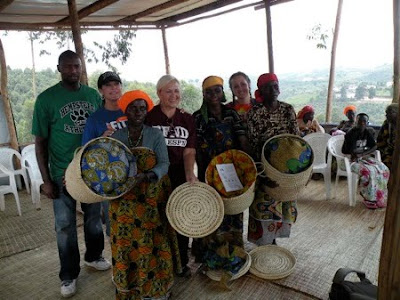
the first three fireless cookers we made together...

Saturday, June 5, 2010

Habits

Habits are interesting things... we all have them, but not the same ones. I have many a friend who cannot start the day without coffee in hand. I am not sure if it is the mental jolt they get from the routine of making the coffee - the sound of grinding the dark roasted beans, the aroma emerging like a potent perfume and the taste on the tongue - or, if it is the physical properties of coffee that really make it a morning must. But either way, they seem quite wayward and weary without it! Others, fewer to be sure, need a morning run to properly start the day. (I have never been in this habit!) Some people find morning devotions mandatory to set the day off in the right direction. And as long as I have know these friends, their habits remain as fixed as the north star. The day invariable begins with a cup of hot coffee, a brisk run, some quiet time.

My habits have never been as solid. Other than the obvious hygienic habits (who can feel awake until they have brushed their teeth?), I don't have a set series of activities. That is not to say that I don't have routines, I just don't keep the same ones for years on end! What seems to be predictable is that my routines are bound to turn like the seasons.

Right now my morning ritual involves making a cup of rooibos tea. Selecting a certain pen to write in my journal. Looking over to the mountains of Congo... some sort of visual anchor, I imagine. And then I locate myself by reading email that has come during the night, reading recent FB posts from friends, scanning the headlines in the New York Times and CNN. But it was not always so... for a while I had no desire for tea in the morning. For another set of months I could not see the mountains, the haze was so thick. Even time with the journal fell out of fashion for a spell. And I am alright with that.

I have observed over the years that what works best for me are gentle habits that suit the season of life. These habits are open to a nudge in another direction, be it from my internal or external environment. I don't have tyrannical rituals that demand I obey, enslaving me to one and only one way to begin my day. My habits don't bully me each morning, threatening a bruising if I don't play their way. My habits have always been kind, flexible and sensitive to the world in and around me. I appreciate that about my habits. I am glad they are somewhat organic. They lend me ample structure to start any given day, but are responsive to the seasons that come. So I embrace my semi-organic rituals!

What I know is that my morning ritual will be in place... until it needs to give way to something else. And so I can count on habits changing as I, myself, am ever changing - growing, I hope!

Friday, May 28, 2010

Some Space Required

I have been living in Burundi for a year now. This has become a space for me to try some new things, learn some lessons and even confront some personal unpleasantries, to be candid. As I've shared previously, one thing that has changed rather naturally here is my diet. We began last year with a family routine that included meat on the dinner table about 4 times a week. But then last summer the electricity in the city started to be off more than on, and this presented some challenges for preserving meat and ensuring its freshness. So we ended up eating less meat - none at home and even little elsewhere. We also had a change in house help, and the new person cannot cook tender beef, but he can cook succulent fish. So we began eating fish a few times a week instead. Here we are a year later, and we now are pretty much a meatless household. It just happened in this context, and I am learning that I can eat less meat and still feel healthy and even happy! This space has given me the chance to try something new and learn that it fits me.

I was thinking this week about space, and how you cannot underestimate the unexpected things that can happen when given a bit of undefined space. Last summer we had a couple of friends living with us here in Bujumbura. Here, of all places, they decided to start learning Spanish together. Not Kirundi or French, which are in operation here, but Spanish for their return to Arizona. Every night they would be hold up in their room making flash cards, conjugating verbs and working toward an authentic accent. What happened in that bedroom in Burundi that sparked their interest to learn Spanish with such dedication? I still do not really know. But I can say that they have continued in their linguistic efforts and will be living in Spain this year. Something happened when they had this space to explore something new and try it on. And as a result of taking advantage of that space, they are onto a new adventure!

Another friend came to Burundi and found space to exhale from a toxic relationship, to find space to imagine a life lived differently, to muster enough courage to make a decision and find a bit of healing in the process. We had no expectation for her visit, other to enjoy her presence. But in a place with little expectation there seemed to be an abundance of freedom to explore new possibilities for a new future.

So this has me thinking about space...

I recall, without academic clarity, an image from my seminary days. My Hebrew professor was exegeting an Old Testament text about intercessory prayer. And the concrete image the Hebrew language employed to describe intercessory prayer was one of creating physical space. The picture, she explained, was of a person hemmed in on every side by trouble and hardship, a person with no room to move. The action of intercession, according to the Hebraic language, was making space around the person, pushing back the things that constricted the supplicant, so that there was room to move, to breathe, to exhale. So when we intercede for others, we are asking God to create space around them, to give them space to move free from external pressures. Maybe it is a prayer that allows them just enough space to reach out to God. But while I cannot recall the text or actual word, I have never forgotten that powerful image. When we pray for another, we are making space for them.

And what I am discovering about space is that it is a creative, constructive and cathartic place. Somehow there is space where things within you can unfold. Maybe the space allows new potential to surface, to emerge like green buds sprouting from the dark soil of life. Maybe, as it has been for me, space allows you to try some new habits and see if it fits. There is a non-judgmental place where you can experiment, discover and investigate things you might never try at home. I don't know... I just know that I seem to need lots of space and I definitely benefit from it!

Friends have told Claude and I that we have a way of 'creating space.' We have no idea how we do it, really. We just show up and invite others to do the same. We set a table, put out some food, and are often surprised at what happens when we gather.

So is space a zone we inhabit or a gift we give to others? Is it both? It seems to be hard to define and yet so crucial for those of us longing for transformation. We need space to move, to explore, to try new things and heal from old hurts. Maybe we need to go somewhere for such space, maybe we need to find someone to be that space for us. But I don't think I am the only one who needs space in my life!


Monday, May 24, 2010

Diet & Discipleship

I've been thinking these days about changing my diet. Not because of weight issues or personal heath issues, though that should also warrant consideration in my process. But I am thinking of altering my diet as a matter of discipleship.

Recently I have been reflecting on creation theology, and how our understanding of creation impacts our view of the natural world as well as the implications of creation care for not only the environment, but the poor. I have come to realize, more than ever, that God still loves the cosmos, the world He created and entrusted to us. I now believe that there is a deep connection between humanity and all of creation, and that together we embrace salvation, restoration and even a shared destiny. (Call me a tree-hugger... I now believe the affection is a biblical mandate!) But maybe the more revelatory aspect of my study of creation, and its connection to humanity, is how it affects the most vulnerable people on the planet - the poor. When the natural world starts showing signs of wear and tear (deforestation, contaminated rivers, polluted air, climate change that alters rain patterns, etc.) - the poorest among us feel it first. These changes on the planet change their daily reality in ways I am only beginning to realize.

And so... as a follower of Jesus, I am thinking about changing the way I eat out of love for the planet and the poor, as God is deeply committed to both.

Why my diet? What about my diet is unloving? How can the food I eat be a matter of spiritual consequence? How can I put diet and discipleship in the same sentence? I am learning that the way I eat affects others in ways I never knew before.

I am a hardcore carnivore, I always have been. I love meat, especially beef and pork. I enjoy marinading a tri tip steak and roasting it to perfection. I massage a spice blend of cardamom and cinnamon on pork chops before grilling them. I make some of the best varieties of meatballs, sometimes flavored with fennel and orange, other times with the more classic thyme, rosemary, parsley and garlic... sometimes even with chipotle and mint! I often glaze a pork tenderloin with balsamic vinegar or a mustard glaze and serve with homemade apple sauce. Such pleasure I derive from preparing and eating meat!

However, I discovered recently that my demand for meat is unhealthy. Maybe not unhealthy for my own body (now they say it is processed meats like bacon that really are the culinary villains), but ill advised for the well being of the planet and the poor. Eating so much meat actually harms the ecosystem and threatens those most dependent on it. It is meat production that requires the use of 30% of the ice-free land in the world - and that meat is feeding the west for the most part. (Though reports show that Indian and China are increasing their consumption as they gain wealth, which will increase demand and threaten more land.) It is meat production that is one of the leading causes of water pollution, generation of greenhouse gases, consumption of mass amounts of energy and deforestation. As a matter of fact, the meat industry produced abut one-fifth of all greenhouse gases world-wide... more than transportation! So here is an industry that I regularly support with my consumption habits, and it is doing harm to the environment on a massive scale. And I can do something about it - I can eat less meat and lower a bit of the demand.

As of 2008, 800 million people suffer from hunger or malnutrition. (It is not far-fetched to imagine that many of them surround me here, on the African continent.) Yet, more soy and corn is grown to feed animals than to feed people. So this meat consumption and production does hurt people, it almost takes the food right out of their mouth. The cost of feed for animals is also on the rise, which means prices for grains for people gets higher, and the poor can afford less and less of what they need in their diet. So now my diet, heavy on savory meats, is a cause of a severe lack in their diets... basic grains for their children.

My diet affects the diets of the poor - those that God loves - now this has become a discipleship issue for me. Now my own diet choices become laden with values. What do I value more - my nightly steak, Sunday pot roast, pork chops and apple sauce? Or those who live off the land and need it to hold together, those who cannot feed their family if food prices increase again, those who will loose access to clean water (and the fish in those waters) if meat production continues to contaminate their water source? Is it right for me to have more than my fair share of the food, the land, the environmental resources? Should I consider consuming less (literally) so that others can have more - so that many can have enough? Does what I eat become a matter of justice, even? I am coming to an answer... yes.

This is not an easy thing for me, as I love meat. But I love Jesus more deeply than my own food preferences. I want to follow Him and submit more and more of my life to Him and the world He so loves. And recently, it means changing my diet to be a better disciple. It means eating in a manner that is seasoned with love for the other over my own gluttony.

You are what you eat... so I want to eat in a way that does not deprive others, deplete the earth or diminish the ecosystem we have been entrusted. This is a huge change for me... but following Jesus demands nothing less than a willingness to repent, to rethink our view and embrace His in every aspect of life. So I will eat much less meat, eat more plants and pray there is enough at the table for all of my brothers and sisters around the world.


Tuesday, May 18, 2010

Another Spiritual Discipline?

I have been a terrible blogger lately. Well, I never have seen myself as a blogger. First, I see myself as someone who writes and occasionally posts on a blog or two. Second, to be a blogger would require regularity, treating a blog like a journal or a watch that are part of my daily routine. So, a blogger I am not.

But all this is beside the point. I am a serial journal writer, I have been since college. I have boxes and boxes of journals (uniform composition books, actually) in storage. I always have a journal on my nightstand, it travels with me in my carry-on when I am in transit, it is always with me where ever I go. The routine of writing is soothing, clarifying and, sometimes, enlightening. I have often said that the habit of writing in my journal is, for me, a spiritual discipline. There is a daily routine, safe place to explore internal realities, pray on paper, listen to what comes as the pen spills ink across each page. Of all the disciplines - and I know Richard Foster and Dallas Willard have lists - writing in my journal has been the most enduring for me. The most nourishing. The one I return to, even after a lapse in discipline from season to season.

But maybe blogging is a new spiritual discipline. If so, it is one that thwarts me in different ways. Journaling is about the writing - the words poured onto the page, the pen in hand, motion of creating a personal font as your thoughts materialize in ink. There is a simplicity about it. But I find translating writing to a blog layered with a bit more complexity. Beyond pen and paper... instead of pen and paper... there are websites, blog warehouses like Word Press, Typepade and Blogspot. Other things are necessary like electricity, bandwidth, formating, knowing how to navigate the sites and add media. As formats on various platforms change - you have to keep up and adapt.

So I can write, even habitually. But I get hung up with posting and all the related pitfalls. Once I get a thought out there... that should be it. But posting on a blog from Burundi never seems to be that easy. I trip over changing formats and having to learn them (again). And so my time is tripled because I have to tangle with technicalities, most of which I don't understand. And then there are the contingencies I cannot control - inadequate bandwidth to maneuver the necessary sites or upload posts, or maybe electricity is out altogether and I am shut down. I get easily frustrated by the set backs, the inability to solve technical or formatting problems. I get thrown by bandwidth and electricity... my blogging attempts dashed. So I tend to not post to avoid the irritations, required adjustments and the things I cannot control. Picking up my journal is so much easier... and more private.

But spiritual disciplines are meant to challenge us, to press upon us and produce a person more fully formed, more ready to engage with God in His world. Maybe approaching blogging from Burundi is a way to learn patience, the reality of limits, surrendering to what I don't know, gaining the fortitude to keep trying and learning amid a changing landscape. Maybe instead of avoiding blogs (to avoid frustrations) I should engage the work as a discipline that can teach me something. Maybe this is a new practice that can push me toward fresh personal growth. One thing is certain - blogging from Burundi will be a discipline, something that will require effort and a degree of perseverance.

Dare I try again?

Wednesday, December 23, 2009

Christmas in Burundi

Christmas in Burundi is much different than Christmas celebrated in the United States. Trees remain firmly planted in the African soil, not cut and carried into homes to be decorated. Few people are decking the halls here – save a few westerners who brought some strands of colored lights to hang in their window. I have not heard Christmas carols on the radio or blasting from the sound systems of the local market. No one here is complaining about too many gifts to wrap, too many presents to still buy before the 24th or fighting the holiday traffic around the mall. People are planning to gather in homes for meals to celebrate together, and even at this late date people have room in their schedule to accept invitations and volunteer to bring their holiday cheer to the party.

It is odd to not have the tinsel, carols and gilded trees around. How odd, days before Christmas, to not be making a list and checking it twice – the grocery list, that is! Strange to not be planning the holiday feasts and setting aside hours to prepare them in the kitchen. This is just a different context for Christmas for the Nikondeha family this year, and it takes some getting used to.

But there is something about being free from the holiday hassles and expectations, from the myriad of distractions that I have become accustomed to amid this yuletide season. Christmas without the usual trimmings allows me to contemplate the coming of Christ, to consider the magnificence and mystery of Incarnation, God with us.

Then it dawned on me…

Christmas in Burundi is just the same as Christmas celebrated in the United States. We all will stop, for a moment, and remember the star that marked the sky and marked the coming of Good News to our broken world. We will listen to the Christmas Story and ponder, again, if there is room in the inn – room enough for God’s Miraculous Gift in our own stable of a heart. Shepherds watching, angels announcing, wise men seeking and a virgin birthing will all remind us of the amazing arrival of Jesus into the world He once created, entering the cosmos He so loves and coming close to those who bear His very image.

God is with us – all of us. He is with us as we celebrate in Burundi, as you celebrate in the United States, as you celebrate in Cape Town, Nairobi, Kampala, British Columbia, London, Oaxaca or where ever you are on the globe this season. Christ approaches all afresh this Christmas, arriving as a vulnerable baby who, like every baby, alters our world every day thereafter.

We join you, wherever you are, in welcoming the Prince of Peace to this world again. We affirm with you that our world continues to need His Good News, and we will work alongside Him in the days to come to bring restoration to what is broken, hope to barren places and joy to the world He so loves!

Christmas Blessings from the Nikondeha Family,
Claude, Kelley, Emma & Justin

Tuesday, September 15, 2009

Missing the mountains

Since June I have not seen the large and looming mountains of Congo that sit on the other side of Lake Tanganyika.  They are majestic mountains, lush green and they set an amazing backdrop for the coastline.  There are so many mountains clustered together, it looks like layers upon layers of verdant monuments to stability and awe-inspiring beauty.   I miss seeing the mountains.

When I arrived in Burundi in early May I was greeted by the mountain-scape.  I could enjoy the view from my bedroom window each morning.   I love having them so close at hand - as if I can reach out and touch them after a morning stretch.  Somehow, seeing them off in the distance was comforting.  It was as if, in some mystical way, the mountains became like guardians.  But I have not seen the mountains since June, when the weather patterns changed.  Haze clouds my view - a combination of dirt and dust, pollution suspended mid-air, and other dynamics that remain a mystery to me.  I must say it again, I miss seeing the mountains.

This longing to see the mountains of Congo again has become a metaphor, of sorts.  I think of our work with the poor of Burundi, our friends.  I have seen, large as any mountain range, the goodness of the work.  I have seen with clarity the homes built since June, the land cleared and cultivated - now embracing potato, cabbage and carrot seeds, I have seen children transformed into students in gleaming new uniforms.  I have seen evidence that good things are at work - and at close range.  But there has been a haze settling in recently.  The last few weeks have brought in dust and debris that has obscured my view.  It is, I suppose, inevitable.  Weather patterns change.  External elements shift and I cannot control them, I must wait them out until the rains or winds come.  Until then, I have to remember that the mountains are there.  Despite what I see (or feel), the goodness is there hidden behind the haze of hurt feelings, distrust and sadness.  

I could get to the mountains if I wanted - I could hire a taxi and endure the jostling journey from Bujumbura to the Congolese border.  I could drive into the heart of those mountains, because they are there beyond view.  The mountains have not moved, they are steady and ever-present.  They are not ontologically changed because I cannot see them, they remain.  I know this to be true about mountains, about goodness and about God Himself.

Beyond the haze that can cloud our vision, God is present like the mountains of Congo.  He is steady, vibrant and with a loving largesse that grounds my world.  Haze will come, it is as sure as the shifting weather patterns and turning seasons.  But He is present.  He is at hand.  The clouds do not cause me to doubt Him, only to long to see Him more clearly in the coming days.  
I crave the sight of my beloved mountains.  I long to see those green guardians again, to stand in awe of their majestic magnitude.  I wait for the winds of change (and rains) to come and reveal them once again.  I miss seeing the mountains...

"I will look to the mountains..."